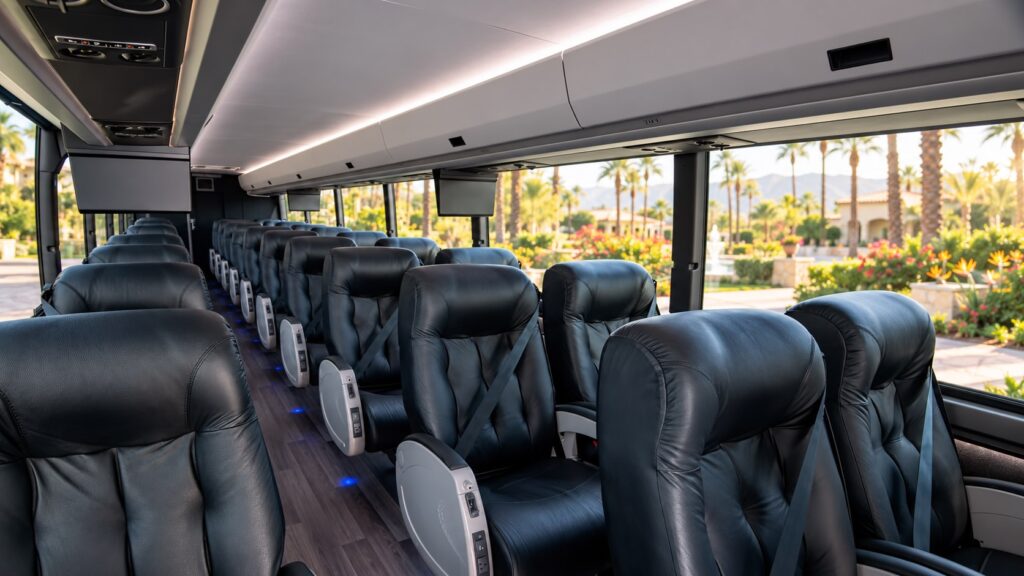
A 33-passenger coach is suitable when the busiest departure has no more than 33 passengers, the actual luggage can be accommodated and the route accepts the full-size vehicle. Check all three together. A comfortable cabin does not solve a narrow entrance, and spare seats do not prove that oversized equipment will fit.
UniSky Express publishes a 33-seat, 2+1 Prevost H3-45 configuration. That is a cabin layout inside a full-size motorcoach, not a description of a small shuttle van. Start with your group’s movements and load rather than choosing a vehicle from its seating number alone.
Count everyone on the busiest leg
Include travelers, tour leaders, event coordinators, coaches and support staff who will ride. Use the largest simultaneous load, not the average number traveling during the day. A coordinator accompanying a 33-person group needs to be counted before the vehicle is selected.
For example, an illustrative group of 29 attendees, two organizers and one guide needs 32 passenger seats. If two additional colleagues join the return, that departure no longer fits a 33-seat plan. The initial outbound headcount is therefore not enough to confirm suitability.
Describe luggage rather than asking whether there is storage
Send a load list with quantities and approximate dimensions. Separate rolling suitcases, personal bags, presentation materials, sports equipment and unusually shaped cases. Note which items must be retrieved at intermediate stops. A group traveling overnight presents a different load from the same number of people attending a local dinner.
- How many checked-size suitcases and carry-on bags are expected?
- Are there rigid cases, long items, coolers or equipment carts?
- Will additional items be collected during the trip?
- Does anything need special handling or separate transport?
- Who will confirm the final load list with the operator?
The coach has underfloor storage and enclosed overhead racks, but published volume is not a promise that every combination of cases fits. Ask the operator to review the real load. Do not plan to use the aisle or an emergency exit area for overflow.
Remember that 33 seats still means a full-size footprint
A 2+1 arrangement describes seating across the cabin. It does not reduce the exterior to minibus dimensions. Send the property its vehicle-access requirements and ask for the approved motorcoach approach, unloading point and staging location.
Private venues, parking structures, hillside roads and hotel motor courts deserve particular attention. A passenger-car map route does not establish coach access. The manufacturer’s H3-45 information describes the vehicle platform; UniSky’s Fleet page describes the published cabin and features. Optional manufacturer equipment should not be assumed to be installed.
Can repeated trips serve more than 33 people?
Possibly, but only as separate confirmed departures. Suppose an illustrative event has 50 riders: the seat calculation suggests two loads, but the second group still needs the coach to unload, return and board again. A single shared arrival deadline may make that sequence impractical.
Ask whether the first group can travel earlier, whether the loading window allows both runs and how the return will work. If everyone wants to leave together, the evening requirement may be more restrictive than the arrival. Repeated trips do not create additional simultaneous seats.
Confirm comfort and boarding requirements before booking
The published cabin includes reclining leather seats, personal lights and tables, Wi-Fi, USB connections and an onboard restroom. Confirm any feature essential to the trip rather than treating a general amenities list as a guarantee of connectivity or a particular working setup.
Describe mobility and boarding requirements directly. A restroom and extra legroom are not the same as wheelchair boarding capability. Do not assume a lift, specific step arrangement or individual assistance is available without confirmation.
A useful suitability request takes five details
Send the busiest-leg passenger count, luggage list, all addresses, required arrival times and boarding needs. Include tentative changes such as additional guests or a later return. UniSky can then assess the actual request instead of answering a capacity question in isolation. Request a coach-fit review before announcing transport arrangements to the group.