Companies planning recurring employee transportation in Los Angeles usually begin with one practical question: what determines the cost of an employee shuttle service?
There is no dependable flat price for a long-term shuttle program. A useful proposal has to reflect the actual route, operating days, shift times, passenger count, service window, vehicle requirements, and contract period. A weekday commuter route is operationally different from a parking shuttle, a multi-site transfer, or transportation for a production crew with changing call times.
This guide explains how a recurring corporate shuttle is evaluated, which details affect the proposal, and what HR, operations, facilities, and procurement teams should prepare before contacting a transportation provider.
Employee Shuttle Pricing Is Based on the Transportation Program
A one-time charter is usually planned around a single itinerary. A long-term employee shuttle is an ongoing operating program with repeated routes, defined arrival requirements, regular passenger demand, and procedures for schedule changes.
The proposal may account for:
- How many days the shuttle operates
- How many trips run each day
- Where the vehicle begins and ends service
- The number and location of stops
- Total driving and on-duty time
- Expected traffic at each service window
- Passenger count and vehicle capacity
- Facility access, loading, waiting, and parking
- The length and structure of the service agreement
For that reason, the most accurate way to discuss cost is to submit a route and schedule for review rather than compare a generic hourly figure.
What Determines Employee Shuttle Service Cost in Los Angeles?
1. Operating frequency
A shuttle running every weekday has a different operating profile from one running twice a week or only during selected projects. The proposal needs the expected service days, holiday schedule, and any seasonal changes.
Also specify whether the service is continuous, split between morning and evening, or scheduled around shift changes.
2. Route length and number of stops
Distance matters, but mileage alone does not explain a Los Angeles route. Multiple employee pickup points, congested streets, difficult turns, and long loading periods can increase the service time even when the geographic distance appears short.
Provide exact addresses whenever possible. A route can then be reviewed for coach access, practical stop order, expected traffic, and safe passenger loading.
3. Required arrival and departure times
Corporate transportation is usually built around an operational deadline. Employees may need to arrive before a shift, meeting, call time, opening hour, or facility handover.
The requested arrival time determines when the route must begin and how much buffer is needed. Peak Los Angeles traffic, event congestion, and facility entry procedures should be considered before publishing the employee timetable.
4. Passenger count and capacity
The expected number of riders affects vehicle suitability and route design. Count actual shuttle users rather than the company’s total headcount. Passenger demand may also differ by day, shift, office, or pickup location.
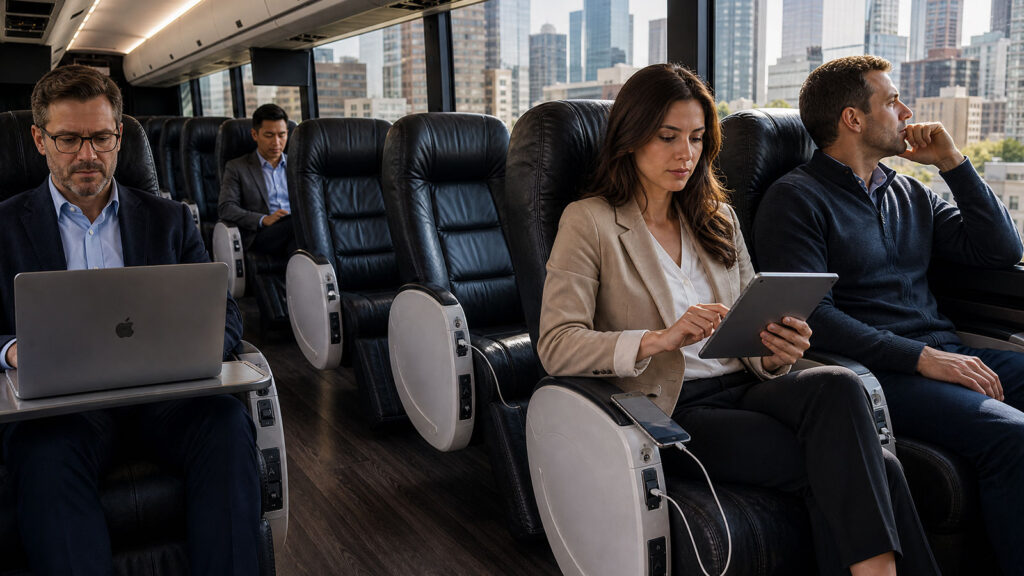
UniSky Express operates a 33-passenger Prevost luxury coach with an extra-legroom 2+1 seating layout. It is best suited to recurring programs where the passenger count, route, and service expectations match that capacity.
5. Total service window
A vehicle may spend time driving, boarding passengers, waiting at a facility, repositioning, or preparing for the return route. The complete operating window matters—not only the minutes employees are sitting onboard.
Tell the coordinator whether the coach should remain available between trips or can be released after each scheduled movement.
6. Shift structure and schedule variation
Standard office hours are easier to model than rotating shifts, weekend operations, overnight schedules, or frequently changing production calls. Programs with several shift changes need each arrival and departure requirement documented separately.
If the schedule changes from week to week, explain how far in advance confirmed times are normally available.
7. Facility, parking, and loading requirements
Office campuses, studios, hotels, warehouses, private facilities, and offsite parking lots may have different access rules. A full-size motorcoach requires appropriate entry, turning, loading, and waiting space.
The proposal may need to account for parking permits, controlled entry, security check-in, designated staging areas, or special site instructions.
8. Contract period
A recurring program should state the intended start date and service period. The operational planning for a short project, a seasonal schedule, and an ongoing employee commute is not identical.
Procurement teams should also identify renewal expectations, schedule review points, and the process for requesting additional trips.
9. Vendor and compliance requirements
Corporate clients may require a W-9, certificate of insurance, operating authority, vehicle specifications, additional-insured documentation, and other onboarding materials. Share the vendor checklist early so the provider can confirm what is available and identify any trip-specific requirements.
Common Long-Term Shuttle Programs
Daily employee commuter shuttle
Employees meet at one or more approved pickup locations and travel together to the workplace. The return route operates after the shift or workday. Planning focuses on consistent arrival, practical stops, passenger demand, and traffic at the scheduled times.
Offsite parking shuttle
A recurring coach connects an employee or event parking area with the primary facility. The program may operate at scheduled intervals or around defined shift changes.
Campus and multi-site transportation
Companies with multiple offices, studios, warehouses, hotels, or operating locations can arrange scheduled group transfers between sites.
Production crew transportation
Film, television, and event teams may require transportation between hotels, crew parking, stages, venues, and production locations. Call times, equipment, access instructions, and schedule changes should be included in the request.
Club and team transportation
Clubs and athletic teams can submit repeated training, match, tournament, or event schedules for review. Passenger count, luggage, equipment, and long-distance travel requirements all affect the operating plan.
What Is Included in a Long-Term Shuttle Proposal?
A useful proposal should clearly describe the service being evaluated. Depending on the transportation program, it may document:
- Vehicle type and passenger capacity
- Service days and operating times
- Approved pickup points and destinations
- Number of scheduled trips
- Waiting or staging requirements
- Planned contract period
- Included operating assumptions
- Items handled separately
- Schedule-change procedures
- Vendor and insurance documentation
Do not compare proposals based only on the final number. Confirm that every provider is quoting the same route, schedule, service window, vehicle, and responsibilities.
Questions Corporate Procurement Should Ask
- Is the carrier properly licensed and insured?
- What vehicle will normally be assigned?
- Does its capacity match expected ridership?
- Who manages day-to-day communication?
- How are schedule changes submitted?
- How are additional trips reviewed?
- What documents are available for vendor onboarding?
- What assumptions are included in the proposal?
- What happens when the requested route or operating hours change?
- Will any portion of the service be farmed out?
These questions help HR, operations, and procurement compare service scope and operating risk—not simply price.
Information Needed for an Accurate Employee Shuttle Proposal
Before requesting a proposal, prepare:
- Company or organization name
- Primary contact and department
- Desired start date and expected service period
- Days of operation
- Exact pickup and destination addresses
- Required employee arrival times
- Return departure times
- Estimated riders for each trip
- Shift and holiday variations
- Facility access and parking instructions
- Vendor onboarding requirements
If some details are not final, identify what is confirmed and what remains flexible. A coordinator can then explain what else is needed to evaluate the program.
Frequently Asked Questions
Does UniSky Express publish a standard employee shuttle price?
No. Recurring transportation is quoted around the actual route, schedule, frequency, passenger count, operating window, and contract requirements.
Can a shuttle run every weekday?
Weekday and other recurring schedules can be reviewed based on route, timing, passenger demand, vehicle availability, and service requirements.
Can the route include multiple pickup points?
Yes, when the proposed stops have practical coach access and can fit within the required schedule. Exact addresses are needed for route review.
Can brokers or other operators request long-term capacity?
Yes. Licensed charter brokers and transportation operators can contact UniSky Express about recurring shuttle, farm-out, overflow, and group transportation assignments that match the 33-passenger coach.
What compliance documents are available?
Corporate clients and partners can request available operating authority, insurance, W-9, vehicle specifications, and related compliance documents during vendor review.
Request a Long-Term Employee Shuttle Proposal
UniSky Express provides recurring employee and group transportation in Los Angeles using a 33-passenger Prevost luxury coach. Send your route, service days, shift times, expected passengers, and contract period. A charter coordinator will review the operating requirements and prepare a proposal around the actual program.
Discuss Your Employee Shuttle Program
Need transportation for an upcoming program? explore the Los Angeles employee shuttle service and share your dates, passenger count, pickup locations and schedule for a customized review.
Pingback: Corporate Transportation Partner Los Angeles | Buyer Guide