How should a company choose a long-term transportation partner?
Compare providers against the same route, operating days, arrival requirements and passenger count. Confirm the operating carrier, vehicle configuration, available insurance and authority documents, change procedures and coordination responsibilities. A recurring agreement should describe the actual service scope and how proposed changes are reviewed, rather than assuming unlimited trips or guaranteed capacity.
Choosing a long-term corporate transportation partner is different from booking a bus for one event. A recurring employee shuttle, parking transfer, production route, or multi-site service becomes part of the company’s daily operation. Reliability, communication, compliance, and route planning matter every time the vehicle runs.
This guide helps HR, operations, facilities, administration, and procurement teams evaluate a corporate transportation partner in Los Angeles. It explains what to verify, what to include in a request for proposal, and how to compare providers beyond a single quoted number.
Define the Transportation Program Before Comparing Vendors
A provider cannot evaluate an ongoing shuttle accurately without understanding the operating requirement. Begin with a written service outline that every prospective vendor receives.
Document:
- Desired start date and expected contract period
- Days of operation
- Pickup points and destinations
- Required arrival and departure times
- Number of trips per day
- Estimated passengers for each trip
- Shift, holiday, and seasonal variations
- Facility access and loading instructions
- Luggage or equipment requirements
- Vendor onboarding requirements
When every provider reviews the same scope, procurement can compare service plans more fairly.
Verify Operating Authority and Insurance
A corporate shuttle provider should be able to supply relevant operating authority and insurance information for review. Depending on the program and company policy, procurement may request a W-9, certificate of insurance, vehicle information, and additional-insured documentation.
Ask the provider to identify the legal operating entity that will perform the service. Corporate clients can also use the FMCSA SAFER Company Snapshot to review publicly available federal carrier information.
Do not rely only on a brand name or booking website. The proposal should explain whether the company is the operating carrier, a broker, or a transportation manager assigning the trip to another licensed carrier.
Confirm the Vehicle Matches the Program
A large vehicle network can offer flexibility, while a direct operator may provide clearer information about the coach assigned to the route. Neither model should be evaluated by marketing language alone.
Confirm:
- Vehicle type and passenger capacity
- Seating configuration
- Luggage and equipment storage
- Wi-Fi and power availability
- Restroom availability
- Facility access requirements
- How vehicle substitutions are handled
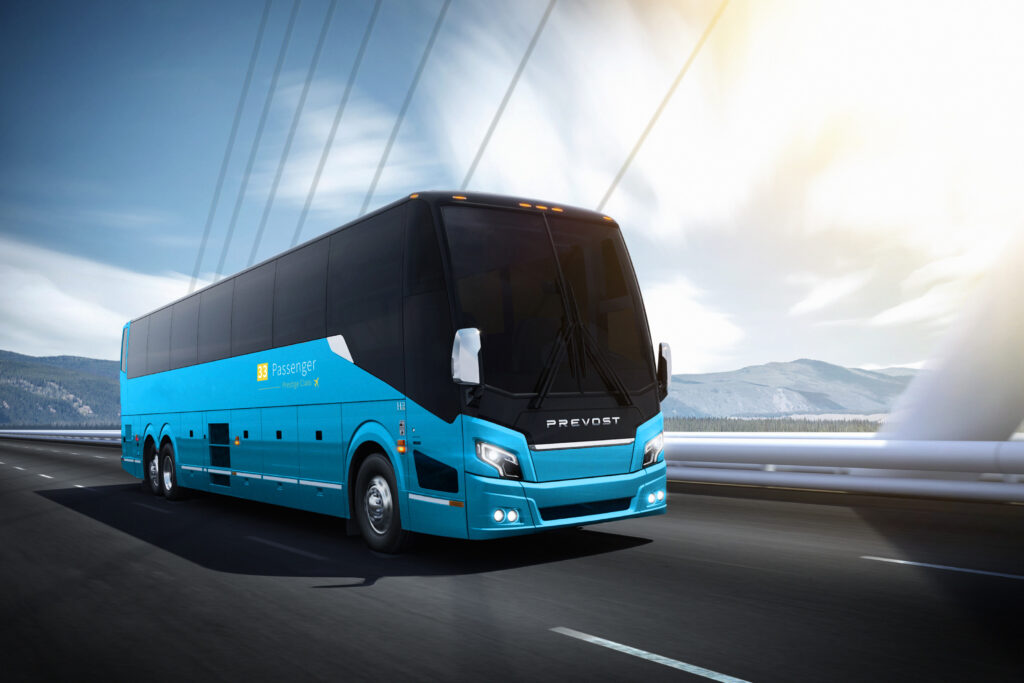
UniSky Express operates a 33-passenger Prevost H3-45 with an extra-legroom 2+1 seating layout, reclining leather seats, Wi-Fi, USB and power connections, overhead storage, underfloor luggage capacity, and an onboard restroom. It is suited to programs where passenger demand and route access match a full-size luxury coach.
Evaluate Route-Planning Capability
A recurring shuttle should be designed around employee arrival requirements, practical pickup points, traffic conditions, and coach access. The shortest-looking route is not always the most reliable route in Los Angeles.
A transportation partner should ask about:
- Where employees are concentrated
- Which arrival time is operationally critical
- How long boarding normally takes
- Whether stops can accommodate a motorcoach
- Peak traffic during each service window
- Security, gate, and parking procedures
- Return and shift-change requirements
Be cautious when a proposal is prepared without exact addresses, times, passenger estimates, or access details.
How should schedule changes be handled during a shuttle contract?
Long-term transportation requires an operating relationship after the contract is signed. Ask who will manage regular communication and how the company handles routine changes.
The service plan should clarify:
- The primary contact for HR or operations
- How schedule updates are submitted
- How much notice is requested for changes
- How additional trips are reviewed
- Who communicates facility-access updates
- How passenger or route concerns are documented
- What information is needed for urgent requests
A named coordinator helps reduce confusion, but the responsibilities and communication process should still be documented.
Ask About Drivers and Hours-of-Service Planning
Recurring schedules must be compatible with applicable driver-hour requirements. Long service windows, split shifts, overnight operations, and changing production calls may require additional planning.
Federal rules for passenger-carrying commercial drivers generally limit driving and on-duty time. The FMCSA passenger-carrier hours-of-service guidance explains the federal framework.
Provide the complete service window—not only passenger travel time—so the operator can review driving, waiting, repositioning, and return requirements.
Should a company choose a direct carrier or a charter broker?
Corporate transportation may be sold through a direct carrier, a charter broker, or a managed network. Brokers can be useful when a client needs multiple vehicle sizes, several cities, or additional capacity. Direct operators can provide detailed information about their own equipment and local operations.
Procurement should ask:
- Who will operate the assigned vehicle?
- Will any service be farmed out?
- How is the operating carrier selected?
- When will the carrier identity be confirmed?
- Which party provides insurance and compliance documents?
- Who manages schedule changes and service communication?
Farm-out is not automatically a problem. The important issues are transparency, carrier qualification, documentation, and clear responsibility.
How can procurement compare corporate shuttle proposals fairly?
Two proposals may show different totals because they are based on different assumptions. Before making a decision, confirm that each provider is quoting the same:
- Route and stops
- Operating days
- Number of daily trips
- Service window
- Passenger capacity
- Vehicle type
- Waiting and staging requirements
- Contract period
- Included responsibilities
- Change procedures
A proposal should state what is included, what is excluded, and which assumptions could change the final agreement.
For more detail, read what determines employee shuttle service cost in Los Angeles.
What should be checked beyond the number of passenger seats?
A vehicle may have enough seats but still be a poor fit for the location or schedule. A full-size coach requires appropriate streets, entrances, turning areas, loading zones, and staging space.
Before approving a route, share photos, maps, facility instructions, or an onsite contact when access is uncertain. The transportation plan should also consider how employees reach the pickup point and how attendance is managed.
Use a Pilot or Initial Review Period When Appropriate
Some organizations may choose to begin with a defined initial period before expanding a recurring transportation program. This can help both parties review actual ridership, boarding time, route performance, facility access, and schedule assumptions.
Any pilot or review period should have documented goals. Identify what will be measured, who will collect feedback, and how proposed route or timetable changes will be approved.
Corporate Shuttle Vendor Checklist
Before selecting a provider, confirm that your team has reviewed:
- Legal entity and operating role
- Operating authority and insurance
- Vehicle specifications and capacity
- Route and coach access
- Driver-hour compatibility
- Service days and schedule
- Communication contacts
- Schedule-change process
- Farm-out and subcontracting disclosure
- Vendor documentation
- Contract assumptions and exclusions
- Process for reviewing service performance
Frequently Asked Questions
Should we choose a direct carrier or a charter broker?
It depends on the program. A direct carrier may be a good fit when its vehicle and operating area match the requirement. A broker or network may help when the company needs several vehicle types, multiple regions, or additional capacity. In either case, confirm who will operate the service.
What documents should corporate procurement request?
Requirements vary by company, but common requests include a W-9, certificate of insurance, operating authority information, vehicle specifications, and any required additional-insured documentation.
How early should we request a recurring shuttle proposal?
Begin once the route, approximate passenger count, operating days, and required arrival times are known. More lead time allows for route review, vendor onboarding, documentation, and schedule refinement.
Can the route change after service begins?
Changes can be reviewed, but they may affect operating time, mileage, driver requirements, access, capacity, and the service agreement. Submit proposed changes as early as possible.
Does UniSky Express work with brokers and other operators?
Yes. Licensed brokers and transportation operators can contact UniSky Express regarding suitable recurring shuttle, farm-out, overflow, corporate, team, and group transportation assignments.
Discuss a Long-Term Corporate Transportation Program
UniSky Express provides recurring employee and group transportation in Los Angeles using a 33-passenger Prevost luxury coach. Send your proposed route, service days, required times, passenger estimate, contract period, and vendor requirements for review.
Request a Corporate Transportation Consultation
Need transportation for an upcoming program? review UniSky Express corporate event transportation or explore recurring employee shuttle service and share your dates, passenger count, pickup locations and schedule for a customized review.
Pingback: Sports Team Transportation Los Angeles | Club Guide
Pingback: Corporate Event Transportation Service Los Angeles
Pingback: Charter Bus Farm-Out Partner Los Angeles | Operator Guide
Pingback: Multi-Site Corporate Shuttle Service Los Angeles