How do you arrange season-long transportation for a sports team?
Build a season calendar showing each confirmed pickup, training site, game venue, reporting time and return movement. Count athletes, coaches and support staff together, then describe luggage and sports equipment separately. Review tentative dates and schedule changes with the operator before confirmation. UniSky Express evaluates suitable team programs against its 33-passenger coach and the complete itinerary.
A long-term sports team transportation program gives clubs, athletic organizations and team managers a repeatable way to move athletes, coaches and staff throughout a season. Instead of arranging every practice, game or tournament as a separate trip, the organization can establish its regular routes, reporting times, passenger count, equipment needs and communication process with one transportation partner.
For Los Angeles teams, that consistency matters. Training facilities, airports, hotels and competition venues may be separated by significant traffic and travel time. A season plan helps the transportation coordinator prepare for recurring trips while still allowing individual schedules to be confirmed as dates and locations change.
What is a long-term sports team transportation program?
It is an ongoing charter arrangement designed around a team’s calendar rather than a single event. Depending on the organization, it may include weekly training transportation, home and away games, tournament weekends, airport transfers, hotel-to-venue movements, staff travel or selected fan and supporter trips.
The operating details are documented in advance and then applied to each confirmed movement. This gives the club a consistent planning framework without assuming that every trip will have the same route or timing.
Which clubs benefit from recurring team transportation?
This approach can work for professional and semi-professional organizations, adult leagues, private clubs, academies, collegiate groups and other athletic programs whose transportation needs repeat during a season. It is especially useful when one person or department is responsible for coordinating multiple dates.
- Club and team operations: recurring travel for players, coaches, trainers and support staff.
- Tournament organizers: scheduled movements between hotels, practice sites and venues.
- Travel coordinators: airport arrivals, departures and multi-day itineraries.
- Charter brokers and operators: local Los Angeles capacity for farm-out or overflow assignments.
- Corporate and membership organizations: coordinated transportation for hosted sports activities or supporter groups.
Which trips can a season-long team transportation plan cover?
Practices and training camps
A recurring pickup plan can be built around a training facility, hotel, campus or designated meeting point. The coordinator should provide the reporting time, loading window, passenger list process and any equipment requirements for each movement.
Home games and away games
Game-day transportation may involve more than one departure. Coaches or staff may report earlier than athletes, while equipment and post-game timing can affect the final schedule. Documenting these dependencies helps the provider understand where flexibility is needed.
Tournaments and multi-day travel
Tournament itineraries can include several hotels, fields or arenas, meal stops and schedule changes. A written trip sheet and a designated transportation contact reduce the risk of different stakeholders working from different versions of the plan.
Airport, hotel and venue transfers
Visiting teams may require an arrival transfer, scheduled hotel-to-practice and hotel-to-game transportation, and a final airport departure. Flight information, terminal instructions, equipment volume and contingency contacts should be collected before service.
What should a club provide when requesting a transportation proposal?
A useful proposal begins with operational information. An exact final calendar is not necessary for the first conversation, but the provider needs enough detail to understand the likely service pattern.
| Planning item | Information to provide |
|---|---|
| Program term | Expected start date, season length and approximate number of trips |
| Passenger group | Number of athletes, coaches, trainers and other staff |
| Route pattern | Common pickup points, training sites, venues, airports and hotels |
| Schedule | Typical reporting times, loading windows and return expectations |
| Equipment | Estimated luggage and sports-equipment volume, including unusual items |
| Communication | Primary coordinator, on-site contact and change-approval process |
| Vendor requirements | Insurance, operating authority or compliance documents required by the organization |
These factors also explain why responsible providers do not publish one fixed price for team transportation. A recurring local training route, a late-night away game and a multi-day tournament place different demands on the schedule. The proposal should reflect the actual program rather than a generic number.
How do you count athletes, staff and equipment when choosing a coach?
Passenger count alone does not determine whether a coach is a good fit. Teams should account for coaching staff, trainers, administrators, luggage and sports equipment. Some items may require different storage arrangements, so equipment type and approximate volume should be discussed before the trip is confirmed.
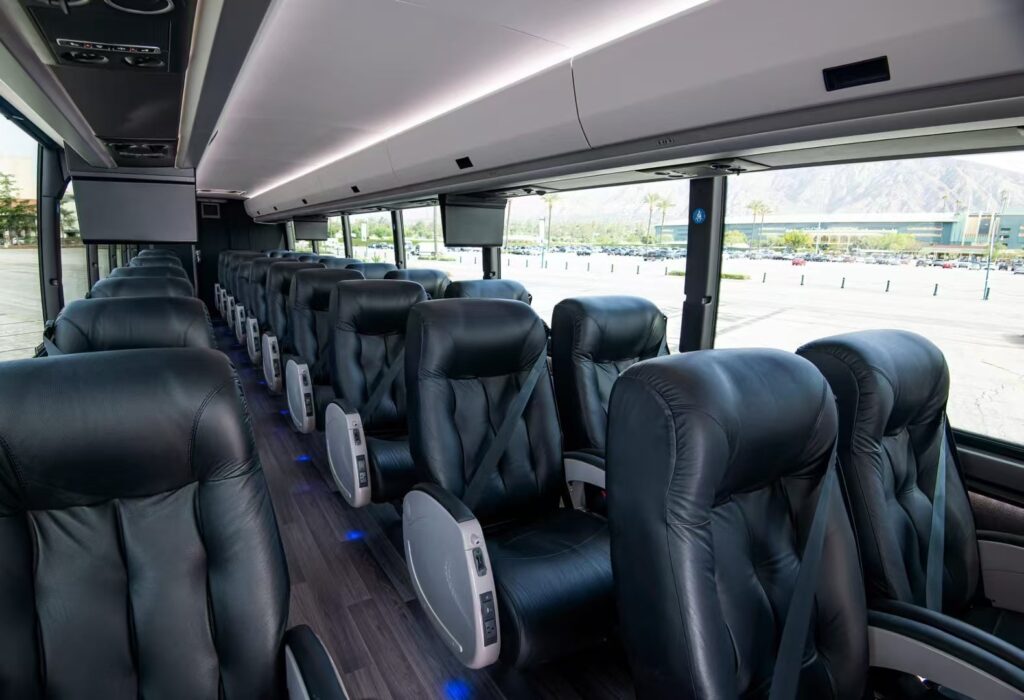
UniSky Express operates a 33-passenger Prevost coach configured with reclining leather seats, Wi-Fi, USB power, an onboard restroom and luggage storage. The vehicle may be appropriate for teams and clubs whose passenger and equipment requirements fit that configuration. Organizations needing a different capacity should discuss the assignment in advance so the operating plan can be evaluated accurately.
Build a communication process before the first trip
Reliable team transportation depends on more than a vehicle. The club and provider should agree on who can approve schedule changes, when final trip details are due, how passengers will be counted and who will be available on the day of service.
A practical trip confirmation should identify:
- the exact pickup and drop-off locations;
- the reporting, loading and departure times;
- the team’s primary and backup contacts;
- the expected passenger and equipment count;
- planned stops and venue access instructions;
- the procedure for approved itinerary changes.
For broader vendor evaluation, teams can also use our guide to choosing a long-term transportation partner in Los Angeles. It covers insurance, compliance, communication and service continuity questions relevant to organizational buyers.
Questions to ask a prospective team transportation provider
- What vehicle will be assigned, and does its passenger and storage configuration match the team?
- Which insurance and operating documents can be supplied for vendor review?
- How are recurring trips confirmed and itinerary changes documented?
- Who is the coordinator before service and the contact on the day of travel?
- How should airports, restricted venue entrances and multi-stop schedules be communicated?
- Can the provider support farm-out or overflow work under the required documentation process?
Sports team transportation FAQ
Can a club arrange transportation for an entire season?
Yes. A club can discuss a recurring program covering selected practices, games, tournaments or transfers. Dates should still be confirmed according to an agreed process because schedules and availability can change.
Can one program include airport, hotel and game-day transportation?
Yes. These movements can be organized under one operating plan when flight details, hotel addresses, venues, passenger counts and reporting times are provided.
How far in advance should a team begin planning?
Begin as soon as the season framework and major dates are known. Early planning creates time to review vehicle fit, schedule patterns and vendor documentation. Final details can be confirmed as the calendar develops.
Is a 33-passenger coach suitable for every sports team?
No. Suitability depends on the combined number of athletes, coaches and staff as well as luggage and equipment. UniSky Express should review those requirements before confirming that its 33-passenger configuration fits the assignment.
Do you publish a standard season price?
No. Program length, frequency, routes, reporting times, trip duration and operational requirements vary. A proposal is prepared after the team’s actual transportation pattern is reviewed.
Discuss a recurring transportation plan for your team
If your club, athletic organization or charter partner needs recurring sports team transportation in Los Angeles or for West Coast travel, share your estimated season dates, passenger count, common routes and equipment needs with UniSky Express. We can review the program and discuss whether our 33-passenger luxury coach fits the assignment.
Request a team transportation proposal or call (225) 803-8239 to start the conversation.