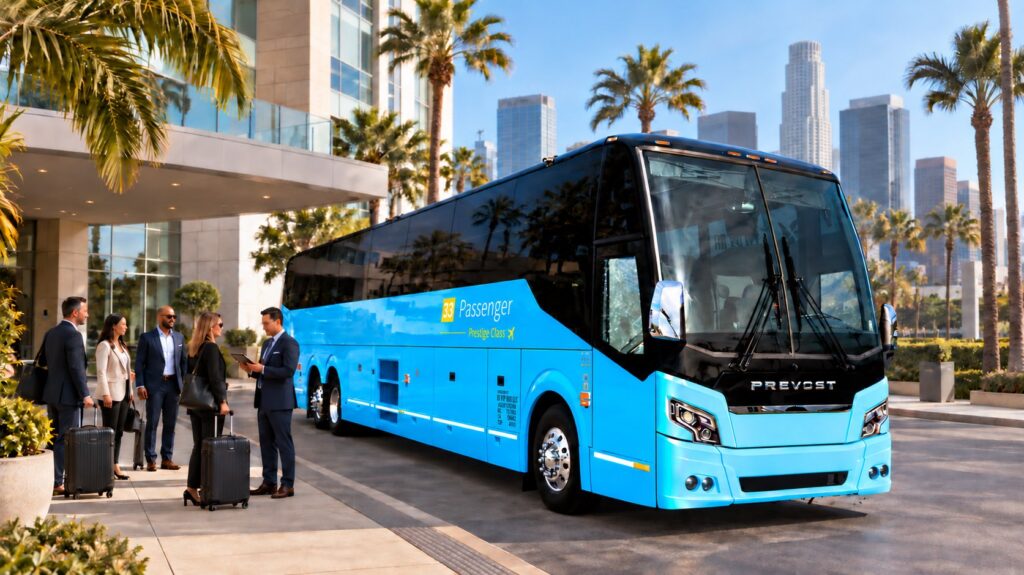
To rent a charter bus in Los Angeles for a company group, define the full itinerary, count everyone traveling and ask the operator to review the vehicle, loading locations and schedule. Before confirming, make sure the written proposal describes the same outbound journey, return service and event-day movements your team expects.
The details that change a booking are often easy to overlook: a coordinator who also needs a seat, a hotel entrance that cannot accommodate a coach, or an event that ends later than the planned return. You do not need every detail finalized to start a conversation, but you should identify which requirements are fixed and which are still estimates.
1. Decide what you need the coach to do throughout the day
Start with the movement of people rather than the length of the event. An office-to-venue transfer, a return after dinner and a shuttle operating repeatedly between two properties are different assignments.
| Trip structure | What the organizer should define |
|---|---|
| One-way transfer | The pickup, passenger count and required destination arrival. Arrange the group’s later transportation separately if needed. |
| Outbound and return | Both journeys, including where and when the group will reboard. |
| Coach needed during the event | Every anticipated movement, waiting requirement and approved staging location. |
| Repeated shuttle runs | Riders per departure, the route cycle and any shared arrival deadline. |
| Multi-day company trip | Each day’s movements, hotels and required service windows. |
“An eight-hour company event” is not yet a transport schedule. Explain whether employees stay at one venue or move between meetings, meals and hotels. Ask the provider to confirm the service scope and associated fees for your requirements; do not assume the vehicle remains available throughout the event.
2. Count seats for the busiest movement, including the return
Count employees, guests, coordinators and accompanying staff together. Then check each departure individually. The number traveling back can be higher if some people reach the venue independently but join the group for dinner and the return.
For an illustrative company outing, 28 employees, two organizers and three visiting clients require 33 seats. If two colleagues later join the return trip, that departure no longer fits a 33-passenger configuration. Counting only employees would hide the problem.
UniSky Express’s published Prevost H3-45 configuration has 33 passenger seats in a 2+1 layout. This is a full-size motorcoach with a lower-density cabin, rather than a compact minibus. Review the actual coach layout and specifications when evaluating fit.
Can one coach carry a larger group in several trips?
Possibly, if the complete cycle fits the schedule. The coach must load the first group, reach the destination, unload, return and board the next group. A short one-way journey does not make the return journey and boarding time disappear.
If everyone must attend the same opening session, the earlier group may need to leave substantially sooner. Confirm that the destination can receive them and that the second group can still arrive on time before treating repeated trips as the solution.
3. Separate the boarding time, departure time and required arrival
These are three different instructions. “Meet at 8:00” does not tell employees whether they should be waiting at the stop or whether the coach leaves at that time.
Work backward from when the group needs to be inside the meeting or event. Allow for unloading, walking and any check-in procedures, then review the travel and boarding schedule with the operator. Check timing for the intended travel day and period rather than relying on a quiet-time map estimate.
Give the provider the fixed deadline and let the route discussion establish a practical departure plan. For a repeat program, also review our employee shuttle route-planning guide.
4. Ask each property where a full-size coach can load
A hotel address identifies the property, but it may not identify the motorcoach entrance. Before distributing pickup instructions, obtain the approved loading point and any gate or security directions from the property.
Ask whether the coach may wait onsite, where it should stage between movements and whether there are access restrictions. Confirm parking responsibilities and any associated fees as part of the itinerary discussion. Loading, waiting and parking may involve different locations.
For a multi-hotel route, repeat this check for every property. Adding a hotel adds more than a stop name: it can change the approach, boarding time and travel time for passengers already aboard.
5. Describe luggage and accessibility needs before selecting the vehicle
A passenger count alone cannot establish storage fit. A team bringing laptops for a day meeting has a different load from a visiting delegation with checked suitcases and presentation cases.
Provide quantities and approximate dimensions for large or unusual items. Explain whether equipment travels separately. If passengers have particular boarding or accessibility requirements, describe those needs early so the operator can confirm whether the proposed arrangement is suitable.
Ask about the specific vehicle’s facilities rather than assuming that every charter bus has identical equipment. If connectivity is essential for the itinerary, clarify requirements rather than promising the team uninterrupted working conditions.
6. Compare proposals against one shared itinerary
Two proposals are comparable only when they describe the same work. Before evaluating the total, check whether each provider has included your complete route, passenger count, service windows and return movements.
- Are all pickup and destination addresses listed?
- Does the vehicle configuration fit every departure?
- Are requested waiting and repeated trips understood?
- Are parking arrangements and related responsibilities clear?
- Does the proposal reflect the full multi-day schedule, if applicable?
- Are outstanding assumptions identified?
Fees can be confirmed against the group’s actual requirements. The objective is to understand the proposed service before comparing totals, without treating an indicative conversation as a confirmed reservation.
7. Know who will operate the service and handle changes
Ask which company will operate the vehicle and who coordinates the assignment. If a broker is arranging the trip, establish how the operating carrier and vehicle details will be confirmed. Request the identity and documentation your company needs for vendor review.
For a UniSky Express booking, confirm the proposed vehicle, service availability and coordination contact against the itinerary rather than assuming that a general fleet description guarantees a particular assignment.
If the date, route, passenger count or event finish changes, communicate it as early as possible. The provider needs to review the effect on capacity, access, operating time and fees. Obtain agreement on the revised arrangement; sending a request is not the same as having it accepted.
Review any cancellation, payment or other booking terms supplied for the assignment before committing. Do not infer those terms from another operator’s website or a general industry article.
8. Send one useful request, then distribute the confirmed plan
You can use this format for an initial inquiry:
We are planning transportation for [company/group] on [date or operating period]. We expect [number] passengers, including coordinators and guests.
Pickup: [address and proposed loading point]. Destination: [address]. Required arrival: [time]. Return: [location and proposed departure].
Additional movements: [stops or shuttle runs]. Luggage/equipment: [description]. Accessibility or access needs: [details]. Items still provisional: [list].
Please review vehicle fit, availability and the proposed scope. Our coordinating contact is [name and preferred contact method].
After the booking and final itinerary are confirmed, send employees one clear version showing the boarding point, meeting time, departure and return instructions. Nominate a company coordinator to manage attendance and submit changes through the agreed contact.
For a company event, meeting or recurring transport request, review UniSky Express company transportation and send your proposed itinerary for review. Include any uncertain details so the discussion can resolve them before the group travels.