How do you plan an employee shuttle route in Los Angeles?
Start with the required worksite arrival time, then confirm rider numbers for each departure, shared pickup points, boarding time and coach access. Include the return trip and complete vehicle cycle before setting departure frequency. UniSky Express reviews proposed routes against its 33-passenger Prevost configuration; 33 seats do not mean one coach can cover overlapping routes.
A Los Angeles employee shuttle route planning service should connect rider demand, practical pickup stops, shift arrival times and the capacity of the bus that will actually operate the route. Companies searching for a recurring shuttle provider should evaluate stops, schedules and vehicle capacity together because changing one affects the others.
UniSky Express helps qualifying Los Angeles companies review proposed employee shuttle routes for a 33-passenger Prevost coach. The planning process begins with the worksite and rider requirements rather than a generic route map.
What time should an employee shuttle arrive before a shift?
Work backward from the time employees must be ready to work. Include gate access, security, walking time and shift preparation. A shuttle that reaches the property at the official shift start may already be late for the business.
What employee information is needed to choose shuttle stops?
Use ZIP codes, approximate neighborhoods, transit connections and shift data to identify groups of potential riders. Early planning rarely requires full home addresses.
Separate demand by worksite and shift. Employees who live near one another but start at different times may require different runs.
Choose a route model
| Route model | Best suited for | Main tradeoff |
|---|---|---|
| Transit connector | Employees arriving at a major station | Must align with train or bus arrival patterns |
| Neighborhood hub | Concentrated employee origin areas | Riders must reach a shared stop |
| Remote parking loop | Limited on-site parking | Frequency and queue management matter |
| Inter-site route | Employees moving between company facilities | Demand may change throughout the day |
| Shift route | Warehouses, hospitality or multi-shift operations | Early and late timing needs careful planning |
How should a company choose employee shuttle pickup stops?
A stop should be legal, safe, visible and accessible to the assigned coach. Check curb rules, property permission, lighting, pedestrian access, coach turning space and the ability to wait without blocking traffic.
Give riders a precise stop description. “Near the station” is not an operating instruction.
Use fewer stops when possible
Every additional stop can expand coverage but also lengthen the ride and introduce another loading variable. A direct route with two strong hubs may attract more repeat usage than a long route attempting to reach every neighborhood.
Build a realistic time budget
For each run, account for vehicle positioning, loading, travel variability, site entry and employee walk time. Use a planning range for travel rather than assuming one map estimate will be reliable every day.
- vehicle report time;
- boarding window;
- scheduled departure;
- traffic allowance;
- worksite entry and unloading;
- employee ready-for-work target.
Plan around shifts, not just rush hour
Some programs need early-morning, afternoon, evening or overnight service. Map every shift change and identify which runs can reasonably serve more than one group.
Return service must also reflect overtime, staggered release and employees who miss the scheduled departure. The company should define whether a late backup is offered or whether the published schedule is firm.
Estimate peak riders by run
Do not size the vehicle from total survey interest. Estimate expected riders for each departure, then consider the busiest normal day and any predictable peaks.
Track registered riders, actual riders, no-shows and denied boardings separately. These measures reveal whether the route needs more communication, a schedule change or different capacity.
When is a 33-passenger coach suitable for an employee shuttle?
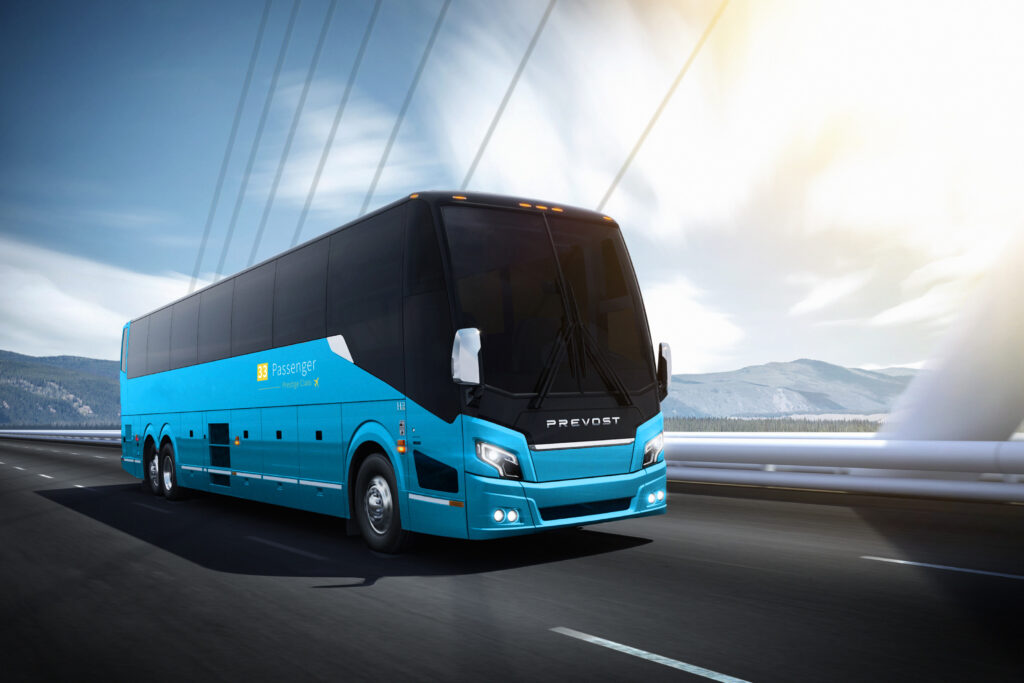
UniSky Express operates a 33-passenger Prevost coach. It may fit a route with a stable rider cluster that needs a single mid-sized luxury coach. The provider should also review bags, equipment, access constraints and turnaround space.
A 33-seat coach is not the right choice for every route. If expected riders consistently exceed the configuration or the loading location cannot accommodate the vehicle, the program requires another solution.
What should you send when requesting an employee shuttle route review?
To receive a useful route review, provide the worksite address, shift-ready time, candidate stops, expected riders by departure, operating days and desired launch period. Include property restrictions and accessibility requirements. A provider should then explain whether the proposed bus, cycle time and loading plan are operationally realistic.
Decide frequency and number of runs
Frequency depends on employee arrival patterns and the route cycle time. A remote parking loop may need repeated departures, while a neighborhood route may operate once per shift.
Calculate the complete cycle, including loading and unloading, before assuming the same vehicle can perform consecutive runs.
Test the route before launch
Conduct a route review using the proposed vehicle where practical. Confirm turns, stops, property access and timing. Then launch a pilot with clear employee instructions.
Our guide on how to set up an employee shuttle service in Los Angeles covers the broader program launch process.
Monitor and adjust
Review ridership and arrival performance by individual run. Avoid changing several variables at once. A stop change, schedule change and communication campaign launched together make the outcome hard to interpret.
Route planning FAQ
How many stops should an employee shuttle have?
There is no fixed number. Use the fewest stops that serve meaningful demand without making the route unattractive or unreliable.
Should stops be close to employee homes?
They should be practical shared locations. Door-to-door coverage usually creates excessive travel time for a recurring group route.
How should Los Angeles traffic be handled?
Use observed timing, planning ranges and periodic review. Build around the required worksite arrival instead of relying on one optimistic estimate.
When should capacity change?
Review consistent peak demand, not one unusual day. Also consider whether schedule or stop changes could redistribute riders.
Request Los Angeles employee shuttle route planning
Share your worksite, shifts, candidate stops and riders per run with UniSky Express. We can evaluate whether a recurring route fits our 33-passenger coach and provide the information needed to continue the service discussion.
Pingback: How to Rent a Charter Bus in Los Angeles for a Company Group